
A standard for open play running in Boulder since 2019
Great ball for all
Pickup volleyball with the arguing taken out.
Rounds to 2 on the base court, feeding a king's court to 7. Written down, so nothing gets negotiated: when the next four are ready at the endline, the answer is already decided. No sign-up, no manager, nobody sitting out.
All the time
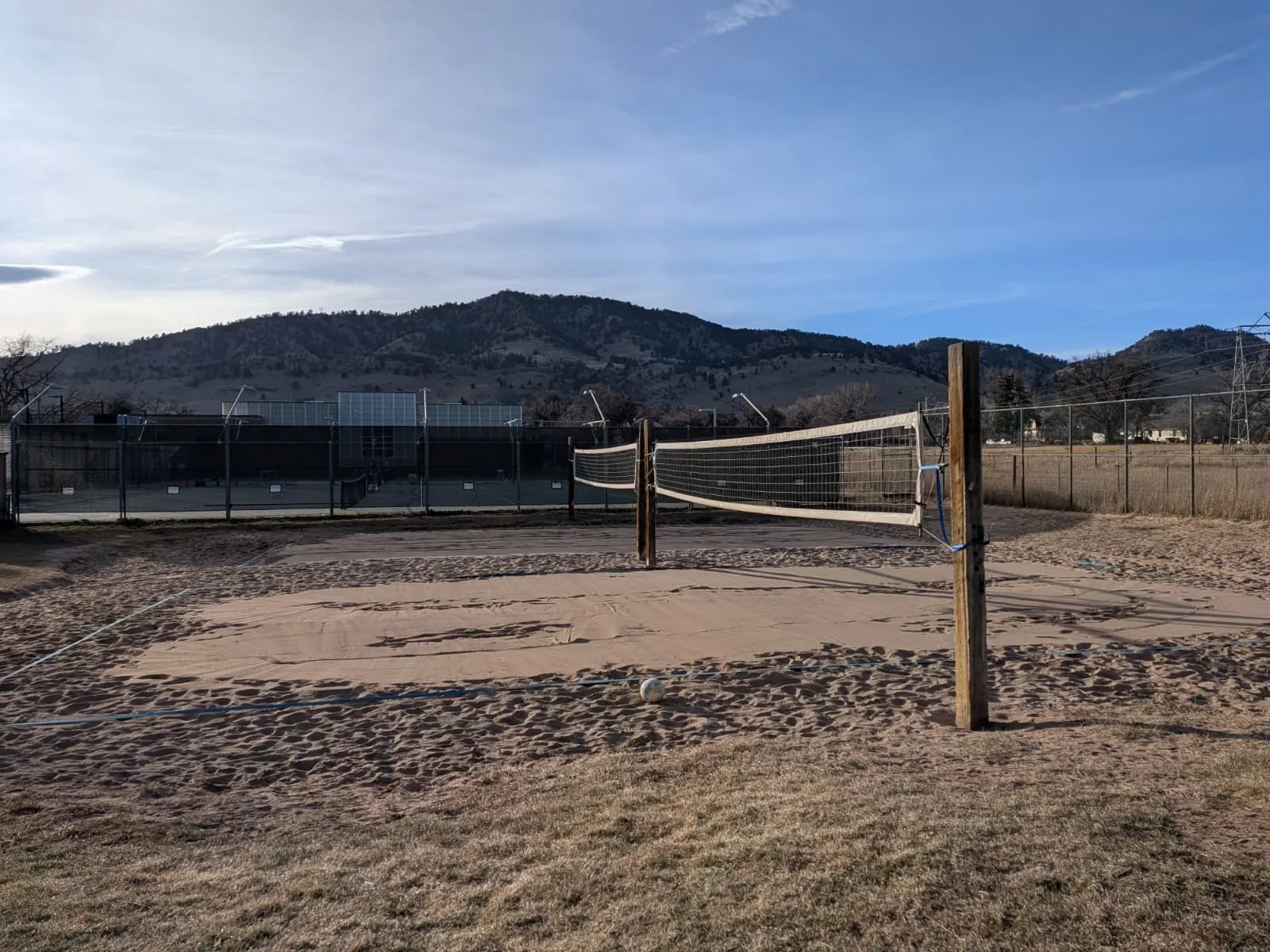
Same court in January. The net stays up.
The crux
Why a round is a game to 2
Every moment worth playing in a 21-point game is already a game to two: the start, the finish, a tie, the swing that settles it. At 19–19 a full game is a game to 2. So play that part, over and over, and skip the filler.
How fast the court turns over
Whether it plays like a real game
2points
Crux round, the VB mean
A game to 2, capped at 2. Short enough to keep the court turning over, long enough to be a real contest, and it gives you every crucial moment of a 21-point game at once.
The meters draw the trade-off rather than measure it. The claim is what matters: two is the happy middle, the volleyball mean.
The flow
One night, however many people show up
Press play and watch an evening run itself. Both nets are busy at once: people trickle in, the king's court opens at eight, pairs earn their way up from below, and later everyone drifts home. Nudge the headcount yourself whenever you like.
0–0
Waiting for a pair to earn their way up
0–0
Waiting for four to arrive
Queue 0
Nobody waiting yet
0 matches · 0 called up
Rounds points on the base court
Win a match on the base court and everyone on your side gets a point. Hit the target and you pick the next highest scorer as your partner, then challenge up; both of you reset. The base court plays a round robin to 3 whenever the line is empty and games to 2 as soon as it is not, so the format follows the queue rather than the clock.
The standard
Written down, so nothing gets negotiated
Six clauses. That is the whole thing. Print it, pin it to the fence, and the court runs itself.
-
1
The round
to 2 · cap 2
A round on the base court is a game to 2, hard capped at 2. No deuce. Two or three minutes, start to finish.
1.1 If nobody is waiting, play all three pairings to 3 instead, so the four on court keep swapping partners.
1.2 The format follows the line, not the clock. The moment somebody is at the endline with a ball, the next round is to 2.
-
2
The point
1 per player, per round won
Win a round and every player on your side earns one point. Points belong to the player, not the pair, and they last all evening.
2.1 Points are only earned on the base court. The king's court is the reward, not another rung.
-
3
The rotation
winners stay losers to the back
Losers go to the back of the line. The next two waiting come on. Because the line feeds in pairs, you get a different partner most rounds, which is the point: you end up playing with everybody.
3.1 Any headcount works. The line absorbs whatever does not divide by four, and nobody waits twice in a row.
-
4
Moving up
reach 3 · pick your partner
Reach three points and you go up. You pick your partner: whoever is next highest on the board. Both of you reset to zero, so the ladder never calcifies.
4.1 Three is the default. Two makes for a faster night, five a more competitive one. Pick one before you start and leave it alone.
-
5
The king's court
opens at 8 first match: to 3, round robin then to 7
Below eight people there is one court, and it is the base court. When the eighth arrives, the four already playing take the second net and open with a round robin to 3: all three pairings, so everyone partners everyone. Whoever tops it keeps the court and picks a partner; the other two go down.
5.1 After that opening, the king's court plays games to 7. Winners hold it. Losers rejoin the line.
5.2 Both nets run at the same time. The base court never stops for the king's court.
5.3 When the group drops back under eight, fold the king's court away. The base court is the last thing to stop.
-
6
Conduct
of, for, and by the players
There is no manager, so keeping play moving is everyone's job. Winners move the moment a match ends. Filling an empty spot is a friendly race. Call your own lines and get on with it.
6.1 Anyone may show up alone, with no team, invitation, or reservation, and play the next round.
6.2 Divisions can split off once there are enough of everyone to sustain them.
Nothing here needs a referee, a spreadsheet, or a person in charge. That is the test of whether it is written well enough.
Run it
What you need to start one
Not much. That is deliberate: a standard nobody can afford to adopt is not a standard.
-
A net and some sand
One net gets you going. A second one lets the king's court open at eight. Tape or chalk for lines if the court has none.
-
Four people
Four is a game. Eight is the full system. You do not need to organise anyone beyond telling them when and where.
-
This page
Print the standard and pin it to the fence. New arrivals read it in a minute and stop asking how it works.
-
Someone to say it out loud
For the first few nights, one person explains rounds to 2 and the points. After that the regulars do it for you.
The first night, honestly
-
1
Start with rounds to 2 from the first serve, even with four people and nobody watching. The habit is the thing you are building.
-
2
Expect to explain the points twice, and expect somebody to ask why it is not to 21. The answer is that you will play more real volleyball in an hour this way. They will feel it by the end.
-
3
Open the second net the moment you have eight. Do not wait for a clean number. The round robin sorts out who holds the court.
-
4
Resist the urge to appoint yourself organiser. If you are running it, it is not running. Point at the fence and play.
Open for all
There is no list to get on
Show up on your own. No team, no partner, no invitation, no reservation. Walk to the endline with a ball and you are in the next round.
- No sittingEvery round has a court for you.
- No win limitsKeep winning, keep playing.
- No sign-upTurn up. That is it.
- No managerOf, for, and by the players.

Challenger-friendly and properly competitive at the same time. The king's court sorts the level out on its own, so a first-timer and a gym rat can both have a good evening. Play near, play far, play now, play in ten years. The more courts that run this way, the better it gets for everyone.
Where it runs
Boulder, Colorado
This is where the standard was worked out and where it has run for years, through summer and through snow. If you want to see it before you run it, come play.
When and where
Courts and times shift with the season and the weather. Ask James and he will point you at the next one.
Who to ask
James Duncan
USAV II CAP Certified
Running it somewhere else? That is the point. Use the standard as written so a player who learns it at one court already knows it at yours.